AI Is Not Your Biggest Threat Right Now. You Are.
- Praful Dandgawal

- Mar 26
- 4 min read
Updated: Apr 16
Exclusive Series: Human Edge in the Age of AI | Article 1 of 4

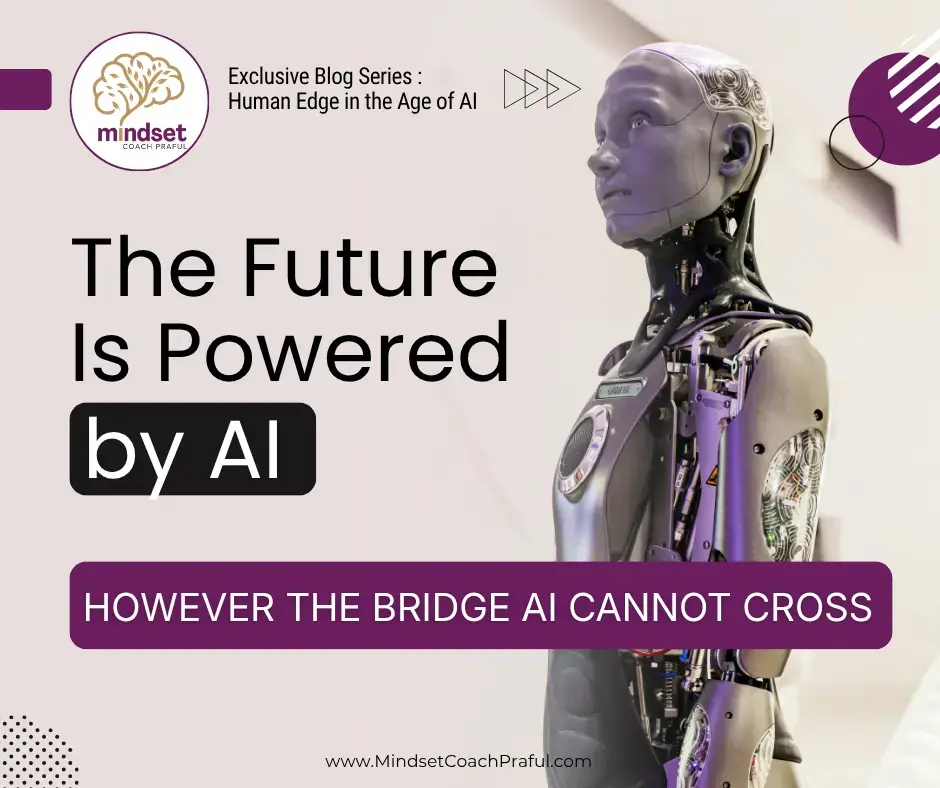
Let's skip the panic for a moment. You've seen the headlines. AI is everywhere. Jobs are changing. Whole functions are being automated. The pressure is real. The anxiety? Earned. But here's what I keep noticing in the leaders and professionals I work with: They're not losing ground because of AI. They're losing ground because — in their rush to keep up with AI — they're quietly outsourcing the one thing AI is unable to replicate now.
Their own thinking. Their judgment. Their humanness.
And the tricky part? Most of them don't even realise it's happening.
The threat that doesn't look like a threat
Here's the pattern showing up everywhere right now.
The pressure to be faster, sharper, more data-backed is constant. So people do what smart people do — they optimise. They lean on dashboards. They outsource analysis to AI tools. They streamline, automate, and compress.
They become more efficient.
And then something quiet starts to slip.
The ability to read a room. The judgment call that no dashboard can validate. The instinct that says "this doesn't feel right" — even when the numbers look fine. The inner signal that separates genuinely great leaders from technically competent ones.
It doesn't vanish overnight. It just... dims. Gradually. Quietly. And nobody flags it because the output is still there. You're still delivering. Still performing. Still showing up.
What the neuroscience actually says
In 1994, neuroscientist Antonio Damasio published a book that quietly upended how we think about decision-making.
His argument, in plain terms:
You cannot reason well without feeling.
Not because feelings make you smarter. But because emotions carry critical data — body signals, pattern recognition, contextual memory — that purely analytical thinking simply doesn't have access to.
He called it the Somatic Marker Hypothesis. When patients with damage to the emotional centres of the brain were studied, a strange thing emerged. Their IQ was intact. Their logic was intact. But they couldn't make decisions. Even simple ones — like choosing between two meeting times — became paralysing. Without emotional input, the rational mind kept spinning, with no way to land.
The book is called Descartes' Error — because for centuries we've been taught that reason and emotion are opposites. Damasio's point is that this is precisely wrong.
Strip out the feeling, and you don't get purer thinking. You get broken thinking.
Now fast-forward to today.
We're not removing emotion surgically. We're doing it voluntarily — slowly, subtly, every time we default to a tool instead of a judgment, every time we trust a metric over a feeling, every time we silence an internal signal because it's harder to defend than a data point.
What "quietly numbing" actually looks like
It doesn't look like a breakdown. That's the whole problem.
It looks like this:
You're still showing up. Still delivering. But there's something flat about how you engage with problems. You're processing information — but not quite thinking about it. Responding to situations — but not quite feeling your way through them.
Your words are technically right. They just don't land the way they used to.
You're functionally present. But inwardly, a little switched off.
"The pressure to do more, faster, can impede insight and decision-making... leaders may trap themselves in 'doing mode,' where quick action overshadows thoughtful reflection — with hefty consequences like poor decisions, burnout, and stifled innovation."
That's not a productivity problem. That's a thinking quality problem.
And it's showing up in boardrooms, leadership teams, and high-performing individuals everywhere — precisely because it hides behind competence.
The irony that should sting a little
Here's the part that should stop you mid-scroll.
AI is very good at several things: pattern recognition, synthesis at scale, speed, recall, processing within defined parameters.
It is architecturally incapable of: reading unspoken tension. Earning trust through a difficult conversation. Making a judgment call that lives at the edge of available evidence.
Staying composed and clear when the stakes are real and the outcome is visible. These aren't soft skills. They're the highest-order capabilities a leader possesses.
And right now — in the age of AI — they are your actual edge.
But only if you protect them.
The bitter irony is this: Fear of AI is making people more machine-like. Retreating into pure execution. Leaning harder on data. Overanalysing. Cutting off the very signals that make their thinking distinctly human.
Exactly when being human matters most, many are choosing not to be.
The high performer's blind spot
There's one more thing worth naming — because it applies specifically to people who are good at what they do.
The more capable you are, the easier it is to drift on autopilot without noticing.
High performers have years of efficient mental models. They're reliable. They produce. And that output — even when it's thinning on the inside — still looks pretty good on the outside.
So no one pulls you aside. No metric flags it. The review is fine.
But if you're honest, something about the thinking feels shallower. The edge is less crisp. That sense of operating from genuine clarity — not practiced competence — is quietly fading.
That gap? It's not a skills issue. It's not a knowledge issue.
It's a thinking quality issue. And more efficiency tools won't fix it.
One question worth sitting with
Before the next meeting, the next deliverable, the next decision —
In the last month, how often have you made a significant call and genuinely trusted your own thinking — not because it was defensible, not because it was data-backed — but because your judgment was clear and you knew it?
If the honest answer is "less often than it used to be" — that's worth paying attention to. That's not weakness. That's information.
If this landed — not just intellectually, but as something you recognise — that recognition is worth paying attention to. Clearer thinking and stronger self-leadership don't happen by default. They require intention. That's the work.
Thinking and accountability partner for senior professionals, leaders, and founders. The work sits at the intersection of applied psychology, neuroscience, and lived business experience — helping individuals think clearly, regulate internal noise, and stay accountable to sound judgment when the stakes are real.
Explore Mindset ReProgramming & High-Performance Coaching for You & Teams