What AI cannot Replicate in Human Decision Making: The Bridge AI Can't Cross today

Updated: Apr 16
Exclusive Series: Human Edge in the Age of AI | Article 2 of 4
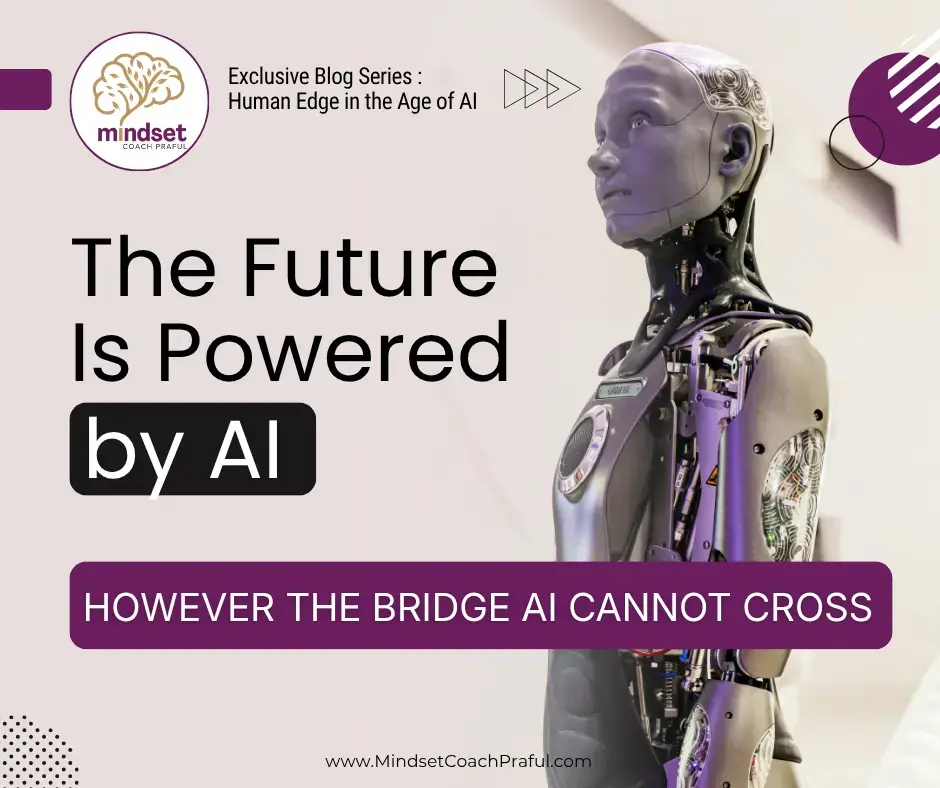
Something interesting happens when you ask AI to make a genuinely hard call.
Not a hard calculation. A hard call.
The kind where the data is incomplete. The room has a certain charge to it. Two people are saying the same words but meaning very different things. And the right move depends entirely on reading what isn't being said.
Watch what happens. The AI processes. It outputs. It gives you something that looks like a decision. But something is missing.
Not accuracy.
Not speed.
Not even coherence.
Depth. The kind that only comes from the full integration of thinking and feeling, simultaneously, in real time. That integration is the bridge AI cannot cross. And in this article, I want to show you exactly why — not philosophically, but neurologically.
Two planes. One decision.
Here's the thing most people get wrong about human thinking.
We assume our best decisions come from logic. From data. From disciplined, linear analysis.
Neuroscience says otherwise.
Damasio's core argument is that emotion and reason are so interwoven that one cannot function normally when one of them is missing. Strip out the feeling — through brain damage, emotional suppression, or the relentless pressure to "just be rational" — and the reasoning process doesn't sharpen. It breaks.
According to the Somatic Marker Hypothesis, when individuals face complex and conflicting choices, purely cognitive processes can become overloaded — emotions are what guide decision-making through the noise.
Think about that for a second.
The feeling isn't the interference. It's the guide.
The body is running a parallel process the whole time you're thinking — flagging risks, surfacing pattern memory, reading relational signals. And without that input feeding into your decision, you don't get purer logic. You get a loop with no exit.
The man who couldn't choose a meeting time
Damasio's most striking case study was a patient he called Elliot.
By every measurable standard, Elliot was fine. High IQ. Clear memory. Intact language, logic, reasoning. Removed a brain tumour, lost part of the frontal lobe — and also, as it turned out, lost his ability to process emotion.
And then something strange happened.
Elliot "knew but did not feel" — his emotional ability was gone, and without it, even simple decisions became paralysing. Both Gage and Elliot lost the structures necessary for reasoning to culminate in decision-making.
He could list every option. Weigh every variable. But he could not land on a choice. Even something as simple as choosing when to schedule a follow-up appointment became an extended, exhausting analysis that went nowhere.
No emotion. No anchor. No decision.
Now ask yourself: what happens to a leader who's been trained — or pressured — to strip emotional input out of their thinking?
Same dynamic. Different cause. Very similar outcome.
What AI is actually doing when it "decides"
Let's be precise here, because this matters.
MIT's Prof. Joshua Tenenbaum — MacArthur Fellow and one of the world's leading cognitive scientists — describes human intelligence as probabilistic inference built from dynamic, real-world interaction, not from static datasets.
AI does the second part very well. It learns from enormous volumes of past data. It predicts what comes next based on patterns.
But it is only ever operating on data it has already seen.
It cannot read the room. It cannot notice the slight hesitation in someone's voice that contradicts what they're saying. It cannot feel that this particular decision, in this particular context, with these particular people, is different from the last time the numbers looked similar.
As ScienceDirect researchers studying AI-human collaboration put it:
"AI's analytical power is inert without the contextual judgment provided by human intelligence."
Human judgment is live. It integrates the past, the present, the relational field, and something harder to name — the felt sense of what this moment is actually calling for.
AI can simulate the output of that process.
It cannot replicate the process itself.
The bridge. Named.
There's a term worth knowing here.
Researchers in cognitive neuroscience call it Head-Heart Integration — the real-time coordination of analytic reasoning (prefrontal cortex) and affective processing (limbic system, including the amygdala and vmPFC).
It sounds clinical.
What it actually describes is something every leader knows experientially:
The moment a complex situation suddenly becomes clear. Not because you found more data. Because something clicked —
analysis and instinct arriving at the same place at the same time.
As researchers LeDoux, Damasio, and Pessoa have collectively established: emotion and cognition are deeply integrated rather than separate processes — emotional stimuli capture attention more readily, encode more deeply, and guide evaluation in ways pure analysis cannot.
THAT INTEGRATION IS A BRIDGE
And here's what makes it fragile: it requires presence. Not performance. Not effort. Genuine, internally regulated presence — the kind that sustained pressure, cognitive overload, and the habit of self-monitoring quietly erodes.
As the IE Business School notes in their research on leadership in the age of AI: intuition isn't guesswork — it's one of the most sophisticated forms of human intelligence, combining experience, emotional insight, and context-sensitive judgment. It works precisely where logic and data fall short.
Why this is harder than it used to be
You might be thinking: "I've always used both thinking and feeling. This isn't new."
You're right. The architecture isn't new.
What's new is the pressure on that architecture.
A Harvard Business School and UC Berkeley study found that AI cannot substitute for human judgment or experience — but crucially, not all leaders are positioned to apply that judgment effectively. The human capacity still depends on the person using the tool.
The irony in that finding is important.
AI is amplifying the value of human judgment — while simultaneously creating conditions that erode it.
More DATA. More SPEED. More NOISE. More DECISIONS per day. More visibility, more pressure to justify everything analytically.
Research examining AI-assisted decision-making across 340 business units found that groups lacking clear human-AI role delineation made significantly worse decisions than either humans or AI systems alone — a phenomenon researchers termed "algorithm aversion meets human abdication."
That phrase deserves a pause.
Human abdication. Not AI overreach. Not technology failure. A human choice — sometimes conscious, mostly not — to hand over the judgment function to a system that was never built to carry it.
So what does this mean for you, practically?
Here's the honest answer:
The bridge doesn't need to be built. You were born with it.
What it needs is protection. Maintenance. Conditions under which it can actually function — rather than conditions that keep degrading it while you keep wondering why your thinking doesn't feel as sharp as it used to.
That means a few things:
Slowing down before high-stakes decisions — not to gather more data, but to let the full integration happen. The analytic mind and the affective system don't sync under rush.
Taking your internal signals seriously — the discomfort, the hesitation, the sense that something doesn't fit despite the numbers looking fine. These are not noise. They're data from a system more sophisticated than any dashboard.
Reducing the cognitive load that fragments attention — because when purely cognitive processes become overloaded, the emotional guidance system that enables good decisions under complexity is the first thing that gets bypassed.
None of this is soft. It's the most demanding kind of mental discipline there is.
The competitive reality
Let me leave you with one uncomfortable truth.
Unilever, in redesigning its global leadership framework for the AI era, explicitly built it around what they called "the human edge" — capabilities AI cannot replicate, including ethical judgment, creative synthesis, and the ability to inspire through genuine human presence. Not as soft skills. As primary differentiators.
The organisations and leaders taking this seriously aren't the ones resisting AI. They're the ones using AI precisely because they understand where the real value lives — and it isn't in the machine.
It's in the thinking quality of the person directing it.
That's the bridge.
It has always been there.
The question is whether you're keeping it strong.
If this reframed something for you — the way you think about thinking, about what you're actually bringing to the table beyond your expertise — that reframe is worth sitting with.
The work of staying genuinely sharp isn't passive. It's a practice. And it starts with understanding what you're actually protecting
Thinking and accountability partner for senior professionals, leaders, and founders. The work sits at the intersection of applied psychology, neuroscience, and lived business experience — helping individuals think clearly, regulate internal noise, and stay accountable to sound judgment when the stakes are real.
Explore Mindset ReProgramming & High-Performance Coaching for You & Teams


