The Fear No High Performer Will Say Out Loud

You're Not Afraid of Failing. You're Afraid of Being Forgettable.
Exclusive Series: The Wiring Beneath | Article 2 of 4

Nobody will tell you this in a performance review.
It won't come up in a 360 feedback. It won't show in your OKRs. And it will almost certainly never be said out loud in a coaching session — at least not in the first few months.
But if you sit with a high performer long enough, in the right kind of conversation, it surfaces. Quietly. Sometimes sideways. But it surfaces.
A question that lives beneath the perfectionism, beneath the relentless drive, beneath the need to control outcomes and stay always on.
Not: "What if I fail?" — that one they can handle.
The real one. The one with teeth:
"What if I become someone nobody notices?"
That's the fear. And it runs more of the show than most people ever acknowledge.
Why this fear is different
Fear of failure is well-documented. It's been studied, named, written about, TED-Talked to death. High performers have heard it so many times that most of them have built sophisticated armour around it.
They'll tell you they're fine with failure — that it's data, that they learn from it, that it's part of the process. And in many cases, they genuinely mean it. Because they've learned to reframe failure as acceptable.
The fear of being forgettable is something else entirely. It doesn't respond to reframing. It doesn't fit into a growth mindset narrative. It can't be managed with better systems or a stronger morning routine.
It lives in a different place — deeper, quieter, and far more personal.
It whispers things like:
"Without this role — am I still significant?"
"If I stopped delivering at this level — would people still seek me out?"
"If I weren't exceptional — would I still matter?"
Nobody says these things in a meeting. But the behaviour they drive is visible everywhere: the inability to delegate, the standards that never feel high enough, the discomfort with being ordinary even for a day.
What psychology has known for decades
Erik Erikson — one of the most important developmental psychologists of the 20th century — mapped the human need for significance across the entire lifespan.
His model of psychosocial development identified a central crisis in middle adulthood: Generativity vs. Stagnation. The deep human need to create something that outlasts us — to matter, to contribute, to leave a mark that persists beyond our immediate presence.
When that need goes unmet — or when it becomes entangled with anxiety — it doesn't disappear. It intensifies. It becomes urgent. It starts driving behaviour in ways the person rarely consciously chooses.
Research published in PMC tracking Erikson's developmental framework longitudinally found that an individual's ability to resolve identity questions earlier in life directly predicted their capacity for generativity — and for wellbeing — in later decades.
In plain terms: the person who never fully separated their identity from their performance tends to arrive at senior levels still running the same anxiety. More successful. More capable. But the underlying question — am I enough without the output? — still unanswered.
"Emotions are not a flaw in the system. They're data. When you feel the pull of significance — the need to be noticed, remembered, indispensable — that is information about what matters to you. The question is whether you're running toward something or away from something."
— Dr. Susan David, Harvard Medical School Psychologist, Emotional Agility
The invisible ceiling it creates
Here's where this gets specific to senior-level performance.
The fear of being forgettable is the single most common invisible ceiling I see in high performers who plateau.
Not lack of skill. Not lack of work ethic. Not even burnout in the conventional sense.
It's this: a person so deeply invested in being exceptional that they cannot afford to not be. They've made being outstanding non-negotiable — not as a choice, but as a psychological requirement. And that requirement starts to narrow everything.
It narrows their risk tolerance. When your identity is fused with your results, any outcome that falls short doesn't just feel like a setback — it feels like an erasure. So you stop taking the kinds of risks that produce breakthroughs.
It narrows their leadership. When you need to be seen as indispensable, you unconsciously resist building people who might one day not need you. You hold knowledge. You don't delegate fully. You stay central to decisions that should be made without you.
It narrows their relationships. People around you — teams, partners, peers — start to sense the fragility underneath the performance. Not consciously. But they feel it. And it creates a subtle but real distance.
Prof. Amy Edmondson of Harvard Business School describes the consequence with precision:
"You no longer have the option of leading through fear or managing through fear. In an uncertain, interdependent world, it doesn't work either as a motivator or as an enabler of high performance."
— Prof. Amy Edmondson, Harvard Business School, The Fearless Organization
What Edmondson is naming at the organisational level plays out internally first. When a leader is privately afraid of becoming irrelevant, they lead from that fear — and it shapes the culture around them before they even realise it's happening.
The Brené Brown thread
Researcher Brené Brown spent decades studying what drives high achievers. What she found — again and again — at the root of perfectionism and performance anxiety was not arrogance. It was shame.
Not the dramatic, visible kind. The quiet, chronic kind. The kind that whispers underneath every exceptional result: not quite enough.
She describes it directly: "I hesitate to use a pathologising label, but underneath the so-called narcissistic personality is definitely shame and the paralyzing fear of being ordinary."
The fear of being ordinary. Not of being bad. Not of failing outright. Of slipping into the background. Of becoming indistinguishable from everyone else.
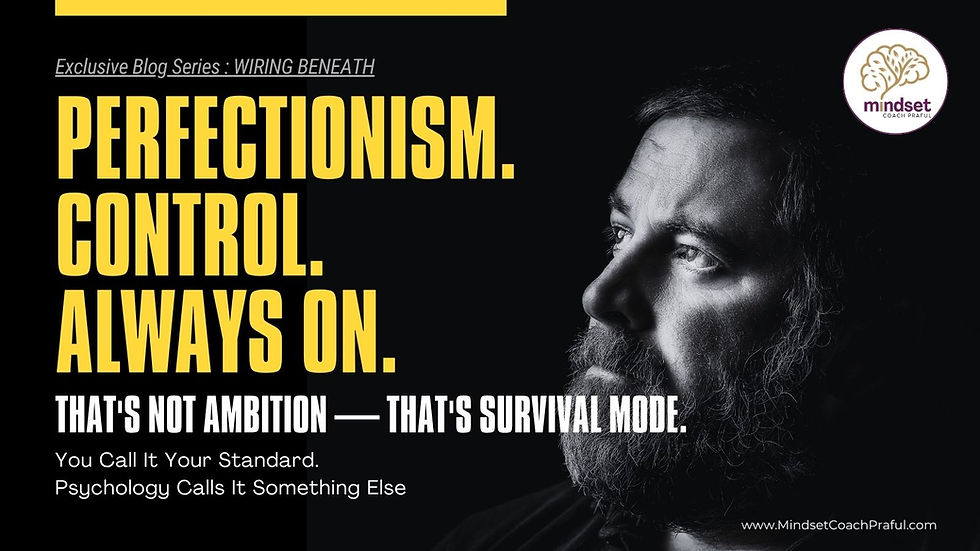
For high performers — people who built their identity on being exceptional — this is the existential terror underneath everything. The thing that keeps the standard impossibly high. The thing that makes rest feel dangerous. The engine underneath the always-on state Article 1: Perfectionism. Control. Always On. That's Not Ambition — That's Survival Mode described.
Because if ordinary means insignificant — then excellence stops being a choice and becomes a survival requirement.
What this actually looks like day to day
This isn't abstract. It shows up in specific, recognisable patterns. Any of these will be familiar:
The compulsive overdeliverer.
The person who cannot submit work without one more revision. Who cannot send an email without rereading it three times. Not because the work isn't good enough — it almost always is. But because something inside registers every incomplete thing as exposure.
The person who can't celebrate wins.
The goal lands. The number is hit. The promotion comes. And within hours — sometimes minutes — the goalposts have moved. There's always a next thing. Not because they're greedy. Because the relief of achievement never fully arrives. The significance they were pursuing was never actually in the result.
The indispensable one.
Always available. Always the person people come to. The one who never fully lets go of anything important. This looks like commitment. It functions as something more specific: the terror of what happens when they're no longer needed.
The one who finds their value in being the hardest worker in the room.
Not because it builds results — often it doesn't anymore. But because stopping feels more frightening than continuing. Because output is the proof of worth. And worth feels conditional.
None of these are character flaws. Every single one of them is an intelligent response to a deeper fear. A fear that has been running quietly, professionally, productively — and at a growing cost.
"The fear of being forgettable isn't a vanity problem. It's a significance problem. And significance that depends entirely on output is the most fragile kind there is — because it only works when everything keeps going well."
— Mindset Coach Praful
The reframe this article offers
Here's the thing worth sitting with:
The need to matter is not the problem. It's one of the most human needs there is. Erikson understood this. Frankl built an entire philosophy around it. The drive to be significant — to contribute something that persists — is a legitimate, profound human motivation.
The problem is when significance gets outsourced entirely to output.
When the only way to feel like you matter is to keep delivering at an exceptional level, the entire internal economy becomes unstable. One bad quarter. One role transition. One period of genuine uncertainty — and the floor drops.
Because the significance was never anchored in something the external world can't touch.
That's the work. Not dismantling the ambition. Not lowering the standard. Separating significance from output — so that one can remain steady while the other fluctuates. Because it will fluctuate. Every career has seasons. Every leader has quarters that don't land the way they should.
The question isn't whether you're extraordinary. You probably are.
The question is whether you know it — in a way that doesn't depend on today's results to stay true.
One question worth sitting with
If you stripped away the title, the results, the reputation — and you sat in a room with someone who knew none of it — what would you bring to that conversation?
Not what you've achieved. Not what you're building. Not your vision or your plans.
Just you. In the room.
That answer — whatever comes up — is where this work goes next.
What's next in this series
Article 3: When Your Identity Becomes Your Ceiling — And Quietly Starts Costing You Everything
When success and identity fuse — when the role IS the person — something starts to cost more than it used to. Article 3 maps precisely what breaks, and why the most capable people often miss it the longest.
If this landed uncomfortably — that discomfort is the signal. The fear of being forgettable doesn't disappear by working harder. It disappears by building a kind of significance that doesn't require constant proof.
That's not a self-help idea. It's the most practical leadership development there is.
Thinking and accountability partner for senior professionals, leaders, and founders whose roles demand clarity, judgment, and composure when it matters most. The work integrates applied psychology, neuroscience, and lived business experience — helping individuals think clearly, regulate internal noise, and stay accountable to sound judgment under real pressure.
Engagements are selective, confidential, and designed for those who value thinking quality and long-term effectiveness over quick fixes. Explore the work→