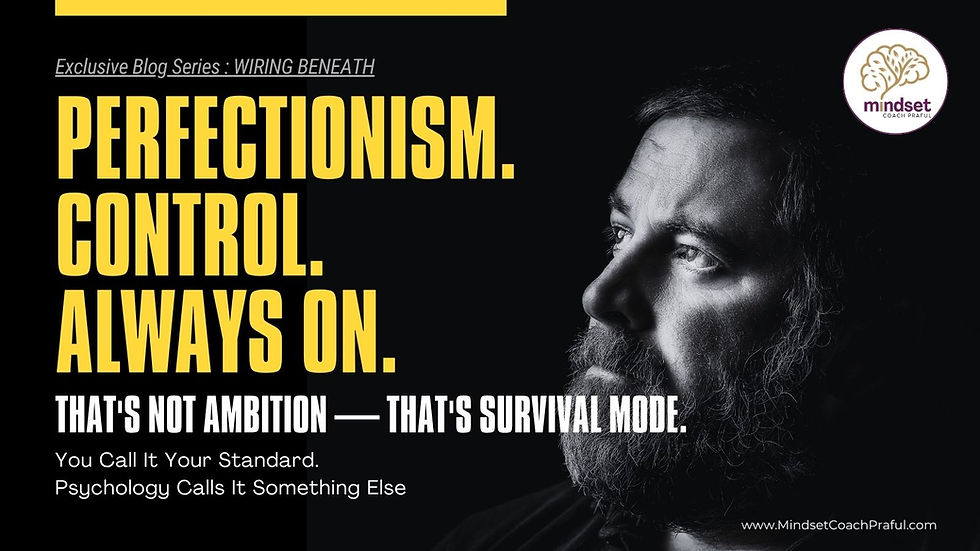
When Your Identity Becomes Your Ceiling— And Quietly Starts Costing You Everything

The Quiet Bargain Every High Performer Makes — And the Bill That Eventually Arrives.
Exclusive Series: The Wiring Beneath | Article 3 of 4

Nobody tells you this is happening while it's happening. That's what makes it so expensive.
The bargain gets made quietly, usually early, and almost always without conscious awareness. High performance becomes the currency of self-worth. Results become the proof of value. The role — the title, the recognition, the being-needed — becomes indistinguishable from the person holding it.
For a long time, this works.
It produces results. It builds careers. It earns respect. The market rewards it. The system validates it. The internal logic is clean: I deliver, therefore I matter.
Until the results slow. Or the role shifts. Or the world changes. Or success simply arrives and doesn't bring what it was supposed to bring.
And then something very specific happens.
Not a crisis. Not a breakdown. Something quieter and, in many ways, more disorienting than either.
The floor that was supposed to be solid turns out to have been held up by outcomes. And outcomes — as every senior professional eventually discovers — are not entirely within your control.
The psychological term nobody teaches in business school
What's being described here has a name in research psychology.
Dr. Jennifer Crocker — Ohio Eminent Scholar in social psychology at Ohio State University, and one of the most rigorous researchers in this space — spent decades studying exactly this phenomenon.
She calls it contingent self-worth.
Her definition is precise: contingencies of self-worth are the domains in which success or failure leads to increases or decreases in self-esteem.
In plain terms:
when you tie your worth to a particular domain — achievement, competence, status, recognition; you make your internal state hostage to that domain's outcomes. Good results feel like more than success. They feel like proof of existence. Disappointing results feel like more than failure. They feel like evidence of inadequacy.
Crocker's landmark research, published in the Psychological Review (2001) and extensively validated since, found something that should stop every high performer in their tracks:
"The pursuit of self-esteem has costs to learning, relationships, autonomy, self-regulation, and mental and physical health. The short-term emotional benefits of pursuing self-esteem are often outweighed by long-term costs. People are often oblivious to the costs."
— Dr. Jennifer Crocker, Ohio State University / Harvard PhD, The Costly Pursuit of Self-Esteem (2004)
Note the last phrase. Not that the costs are inevitable — but that people are oblivious to them. The system runs on autopilot. The price is paid without the invoice ever being opened.
What the bargain actually looks like
Here's how the bargain forms — and why it's so hard to see in yourself.
Early in a career, performance-based worth is almost entirely functional. You deliver results, you get rewarded. The feedback loop is clean. The system makes sense. You are your output, and your output is good, so you are good.
Over time, the stakes rise. The role expands. The visibility increases. And with it — often imperceptibly — the internal architecture shifts.
What started as a motivational mechanism becomes an identity structure.
You are no longer someone who achieves. You are an achiever. The distinction sounds philosophical. The psychological difference is enormous.
Someone who achieves can choose not to achieve today and still be whole tomorrow. An achiever cannot. Stopping feels like disappearing.
This is the bargain. It wasn't signed in a moment. It was ratified slowly, through a thousand small reinforcements — every time the result brought relief, every time approval arrived with the achievement, every time the identity held because the performance held.
How it becomes the ceiling
Here's the specific mechanism that turns this pattern from a motivational asset into a performance ceiling.
When identity is fused with results, the entire internal system orients around protecting that identity. And protection — at the level of the nervous system — is a fundamentally conservative operation.
It avoids the risks that might expose the identity to threat. It hedges rather than commits fully. It undermines the very innovation, delegation, and strategic boldness that senior-level performance actually requires.
Crocker's research maps this precisely: when self-worth is at stake, people pursue strategies to avoid failure — even if they undermine learning. The tendency to discount, excuse, minimise, or forget failures limits how much can be learned from them.
Think about what that means in practice at senior levels:
The leader who can't delegate.
Not because they distrust the team. But because the work is the self — and letting go of it feels like letting go of something existential.
The founder who can't celebrate.
The exit lands. The valuation holds. And within weeks the restlessness is back — not because they're greedy, but because the achievement brought a moment of relief, not the sustained sense of worth it was supposed to deliver. So the next target gets set before the current one has been processed.
The executive who can't receive feedback.
Not intellectually — they can discuss it calmly. But physiologically. Their nervous system registers critical feedback not as information about their work but as a threat to their person. Because the two have become the same thing.
The high performer who peaked externally and feels empty.
The title is there. The recognition is there. The numbers are there. But the internal experience is flat — because the identity was so fused with the pursuit that arriving at the destination turns out to have no there there.
"The most sophisticated ceiling isn't a glass one — it's an internal one. It's the one you built yourself, out of the belief that your worth lives in your results. That ceiling moves every time you reach it. And it always stays just above where you are."
— Mindset Coach Praful
The bill — and when it arrives
The bill doesn't arrive in a dramatic moment. That's the part nobody warns you about.
It arrives in the flatness of wins that should feel bigger. In the exhaustion that doesn't respond to rest. In the quality of presence in relationships that slowly narrows. In the slow erosion of genuine curiosity — the kind that used to make the work interesting before it became a measure of worth.
Crocker's research found that people with highly contingent self-worth experience greater fluctuations in self-esteem in response to everyday successes and failures — and those fluctuations are associated with increases in depressive symptoms over time.
Not crisis. Not clinical breakdown. A slow, chronic wearing-down of the internal weather.
The person who built their confidence on performance finds their confidence becoming fragile precisely at the moment they've achieved the most. Because the higher the stakes, the more exposed the contingency.
As psychologist Carl Rogers — one of the founders of humanistic psychology — framed the alternative: people are worthy of love and respect simply by being human, regardless of their behaviour or achievement. What he called unconditional positive regard.
Most high performers never received this early enough to internalise it. So they built their worth on the only alternative available: conditional achievement. And then they carried that architecture into their most consequential professional years.
What this is not about
Before the actionable section, a necessary clarification. This is not an argument against ambition. Against high standards. Against genuinely wanting to build something significant.
The most effective leaders — the ones whose performance is not just impressive but sustainable — have extremely high standards. The difference is that their standards come from values, not from a need to validate existence through output.
Crocker's research found that goals based on intrinsic values — rather than external validation — foster motivation that supports achievement without the harmful costs.
The ceiling isn't the ambition. The ceiling is the dependency.
Take the dependency away — anchor the worth somewhere that results can't reach — and the ambition becomes generative rather than defensive. The standards stay. The compulsion softens. The performance, counterintuitively, often improves.
What to actually do with this — four moves that shift the pattern
This is not a framework. It's not a system. It's four specific, repeatable practices that begin to decouple identity from output — not theoretically, but experientially.
MOVE 1: Notice the felt experience of wins and losses
→ For the next 30 days, track not what happens — but what you feel when it happens.
→ Not your analysis. Not your reframe. The first, unprocessed internal response.
→ When a result lands well: does relief arrive before satisfaction? That's contingent worth speaking.
→ When something misses: does it feel like information — or like evidence of inadequacy?
You cannot change what you cannot first see clearly. This move builds the clarity.
MOVE 2: Deliberately do something you're bad at
→ Once a week. Something where you are genuinely not impressive.
→ Not as punishment. As practice in existing without being excellent at something.
→ The goal is to find out what remains when the performance is absent.
→ Most people discover more is there than they expected.
→ That discovery — small and repeated — begins to rebuild worth from the inside.
MOVE 3: Identify one area where you're running defensive rather than generative
→ Ask: 'Am I here to protect something — or to create something?'
→ Protection mode looks like: not delegating fully, needing to be in the room, over-reviewing others' work.
→ Generative mode looks like: building people who might one day not need you.
→ Pick one domain — one relationship, one project, one decision — and consciously shift the frame.
Not forever. Just for a month. Notice what changes in the quality of your presence.
MOVE 4: Rebuild the anchor
→ Ask: what is true about me that doesn't change when the results change?
→ Not a virtue list. Something specific. Something you know from direct experience, not aspiration.
→ Write it down. One sentence. Keep it close.
→ This is the beginning of what Crocker calls intrinsic self-worth — worth grounded in who you are, not what you produce.
It doesn't replace the ambition. It stops the ambition from holding you hostage.
The reframe that makes everything else possible
Here is the thing most productivity frameworks miss entirely:
You can maintain extraordinarily high standards without your worth depending on meeting them.
The two are not the same thing. Most high performers have conflated them for so long they've forgotten they were ever separate.
Standards are about what you want to create. Worth is about who you are. The first belongs in every serious professional conversation. The second should never have been put on the table.
Separating them doesn't make the work less important. It makes you more capable of doing it well — because you're no longer performing to protect your identity. You're performing because the work genuinely matters to you.
That distinction changes everything. The quality of decision-making. The quality of presence. The quality of leadership. And it makes the wins feel like they're supposed to feel.
What's next — the final article in this series
Article 4: The Hardest Truth. Most of What's Running Your Life Was Never Actually Yours. The resolution. Not a life overhaul. Not a new framework. One precise, high-leverage question — and what changes when you're honest enough to answer it.
Because the point of this series has never been to diagnose you. It's been to give you back a choice you may not have known you had.
The bargain was never conscious. Which means it can be renegotiated. Not by stopping caring about results — but by stopping letting results decide whether you're enough.
That's the work. It's not comfortable. But it's the highest-leverage thing a senior professional can do.
Thinking and accountability partner for senior professionals, leaders, and founders whose roles demand clarity, judgment, and composure when it matters most. The work integrates applied psychology, neuroscience, and lived business experience — helping individuals think clearly, regulate internal noise, and stay accountable to sound judgment under real pressure.
Engagements are selective, confidential, and designed for those who value thinking quality and long-term effectiveness over quick fixes. Explore the work→